1/24/2026-Page posted
Interpretation of Plant Colors and Structural Details
Purpose of This Analysis
The plant illustrations in the Voynich Manuscript exhibit non-random coloration, exaggerated morphology, and selective anatomical emphasis. This project treats these features as intentional informational layers, not decorative art.
This page documents how plant colors and visual details are analyzed, what is observed, and what is inferred, under the Lost Knowledge Files methodology.
Observed Characteristics (Non-Interpretive)
Across the manuscript, plant illustrations consistently show:
Limited but deliberate color palettes (greens, reds, blues, yellows, browns)
Color separation between roots, stems, leaves, and flowers
Exaggerated or stylized anatomy (bulbous roots, oversized leaves, segmented stems)
Repetition of similar color–structure pairings across different folios
Inconsistencies with naturalistic botanical illustration norms
These features are treated as data, not assumptions.
Core Hypothesis
Plant illustrations function as encoded visual descriptors, conveying information about:
material state
preparation phase
usable plant component
interaction with processes described in the text
Color and structure are interpreted as functional markers, not literal botanical realism.
Color Interpretation Framework
Green
Observed use:
Leaves, stems, and above-ground structures
Often paired with branching or growth emphasis
Interpretation:
Living or fresh material
Active biological state
Vegetative or aerial components
Functional implication:
Ingredients used fresh
Growth-stage relevance
Non-processed material
Red
Observed use:
Roots, internal structures, or isolated sections
Often localized rather than widespread
Interpretation:
Activated or transformed state
Heat-affected, fermented, or chemically altered material
Potent or reactive components
Functional implication:
Requires processing
Indicates intensity, danger, or efficacy
Often associated with later procedural stages
Blue
Observed use:
Flowers, vessels, droplets, or surrounding elements
Appears sparingly and deliberately
Interpretation:
Liquid association
Extraction medium (water, alcohol, decoction)
Volatile or distillable component
Functional implication:
Infusion, solution, or solvent use
Ties to aqueous or vapor-based processes
Yellow / Gold
Observed use:
Seeds, nodules, pollen-like elements, or highlighted regions
Interpretation:
Concentration or refinement
Final product or high-value component
Stabilized or completed form
Functional implication:
Endpoint of a process
Dosage or yield indicator
Brown / Black
Observed use:
Roots, dead matter, soil contact areas
Interpretation:
Fixed or spent material
Residual substrate
Base matter no longer active
Functional implication:
Discarded matter
Structural or grounding component
Post-extraction remains
Structural Detail Interpretation
Roots
Observed:
Frequently exaggerated, segmented, or emphasized
Interpretation:
Foundational material
Primary active ingredient
Source substance
Roots often correspond to early or base-stage processes.
Stems
Observed:
Connecting elements, sometimes segmented or jointed
Interpretation:
Carrier or transition structure
Process pathway
Transport or linkage role
Stems frequently map to procedural flow, not ingredients.
Leaves
Observed:
Repetition, symmetry, or exaggerated size
Interpretation:
Active surface area
Absorption or exposure
Modifier rather than base
Leaves often imply interaction rather than substance.
Flowers / Fruit / Seed Structures
Observed:
Prominently stylized
Often isolated or highlighted
Interpretation:
Output or product
Concentrated result
Purpose of the recipe or process
These elements frequently correlate with end-stage or goal markers.
Non-Botanical Accuracy as a Feature
Many illustrated plants do not correspond cleanly to real-world species. This is treated as intentional.
The working assumption is that illustrations represent:
functional plant families
process-relevant traits
symbolic composites
Rather than literal taxonomic accuracy.
This allows multiple real-world plants to map to a single illustrated form when they share procedural roles.
Relationship to Textual Analysis
Visual analysis is never used in isolation.
Plant colors and structures are evaluated only in conjunction with:
token roles
procedural grammar
sequence logic
cross-folio repetition
Visual interpretation must support textual structure—not override it.
Confidence and Limitations
All color and structural interpretations are:
probabilistic, not absolute
subject to revision
marked as inferred, not observed
Cases where color data conflicts with text-derived structure are flagged rather than forced into alignment.
Summary
Within the Lost Knowledge Files framework, plant illustrations act as compressed visual metadata.
Color and form provide contextual constraints, helping to define:
material state
process stage
functional role
This layered approach allows the manuscript to encode procedural knowledge using both text and image, reducing ambiguity while conserving space.
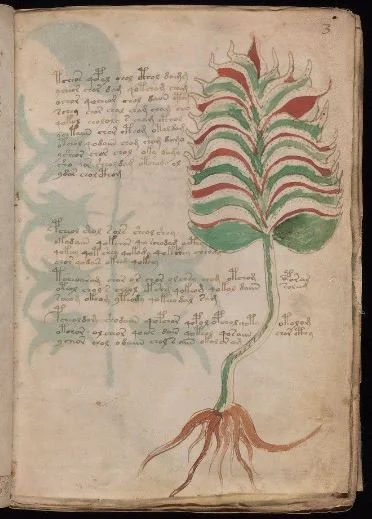
Photos from- https://collections.library.yale.edu/catalog/2002046
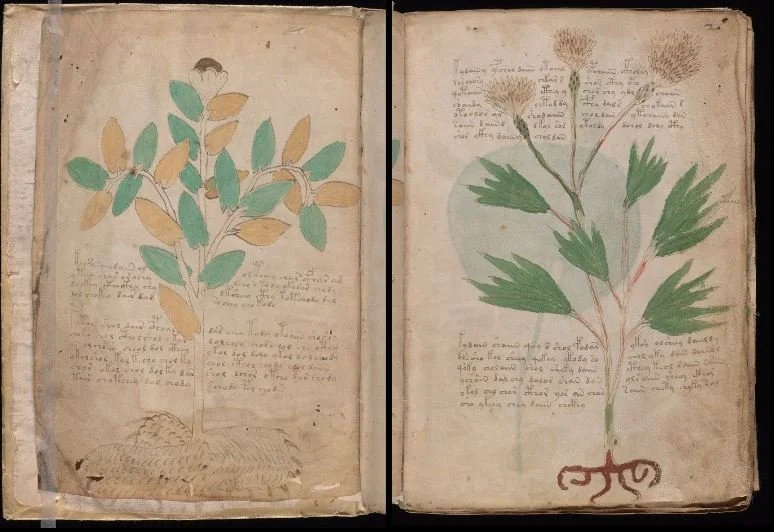
Photos from- https://collections.library.yale.edu/catalog/2002046