My Approach to the Voynich Manuscript
A Procedural, Rule-Based Analysis
Most attempts to interpret the Voynich Manuscript begin with assumptions about language, symbolism, or direct semantic translation. Our work takes a different starting point.
We treat the Voynich Manuscript as a procedural technical document—one that encodes actions, materials, governance rules, and reuse patterns—rather than as a conventional narrative or purely symbolic text.
The core hypothesis guiding this work is simple and testable:
The Voynich Manuscript encodes a structured procedural system whose internal rules remain consistent across the manuscript, regardless of section or illustration type.
Method Overview
Our approach is method-first, rule-based, and deliberately constrained.
Rather than attempting immediate semantic translation, we focus on identifying and validating operational structure, including:
Material introduction and handling
Vessel and process governance
Heat, time, and repetition controls
Base preparation and reuse
Procedural closure and transitions
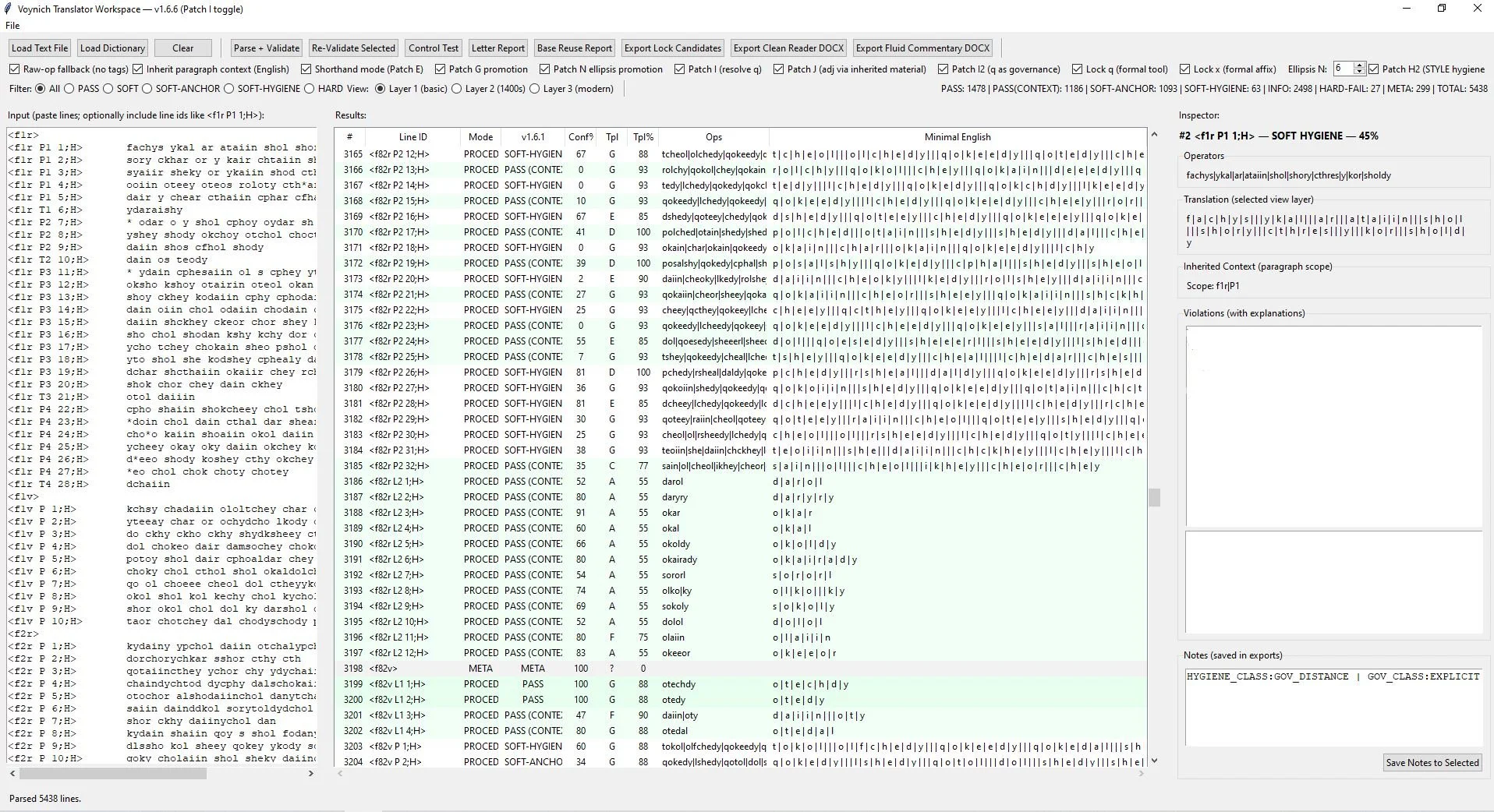
These elements are tracked using a fixed set of operators and rules that are applied consistently across folios.
Importantly, the ruleset is not modified on a per-folio basis. This allows failures, ambiguities, and successes to be observed rather than explained away.
Full-Manuscript Application
The procedural framework has been applied across the entire Voynich Manuscript, including:
Herbal sections
Biological / balneological sections
Zodiac folios
Astronomical and cosmological sections
All folios are processed through the same workspace and rule system, producing structured outputs that record operational sequences, inheritance behavior, and validation status.
While the framework has been applied globally, selected folios are examined in depth as representative case studies. These include:
Text-only base definition pages (e.g., f1r)
Herbal preparation pages with varied morphology
Zodiac folios demonstrating timing, segmentation, and reuse
Stress-test folios chosen specifically for structural or visual deviation
This distinction—full coverage with selective deep validation—is intentional and central to the methodology.
Pressure Testing and Validation
The framework has undergone multiple internal pressure tests, including:
Application to folios with no illustrations
Application to folios with radically different layouts
Cross-section testing without expanding the dictionary or altering rules
Reuse tracking where later procedures reference earlier bases
In these tests, procedural structure and inheritance behavior continue to resolve without requiring ad hoc adjustments. Where ambiguity remains, it is recorded explicitly rather than forced into interpretation.
What This Work Does—and Does Not—Claim
This project does not claim:
A complete semantic translation of the manuscript
Definitive identification of every plant or substance
Chemical, medical, or historical validation of outcomes
Final resolution of the Voynich problem
What it does demonstrate is that:
The manuscript encodes a coherent procedural system
That system operates consistently across sections
Later folios reuse and extend earlier base procedures
Structural meaning can be recovered independently of full linguistic decoding
Released 1/19/2026
Thomas Woolvin
The Lost Knowledge Files